"And he will turn the hearts of fathers to their children and the hearts of children to their fathers" - Malachi 4:6
Fathers leading children to Christ, one magical moment at a time.
The Fathers' 3-10 Initiative, founded by Virgil Anderson, is a global discipleship program designed to help fathers build a stronger relationship with their young children, ages 3 to 10, through Bible-based devotional reading. The program is supported by leading global Christian organizations, including Cru and CEF.
The Fathers' 3-10 Initiative already had a powerful mission, but it used to live in printed booklets, static PDFs, and disconnected local efforts. That limited its reach, its consistency, its measurability, and its long-term impact.
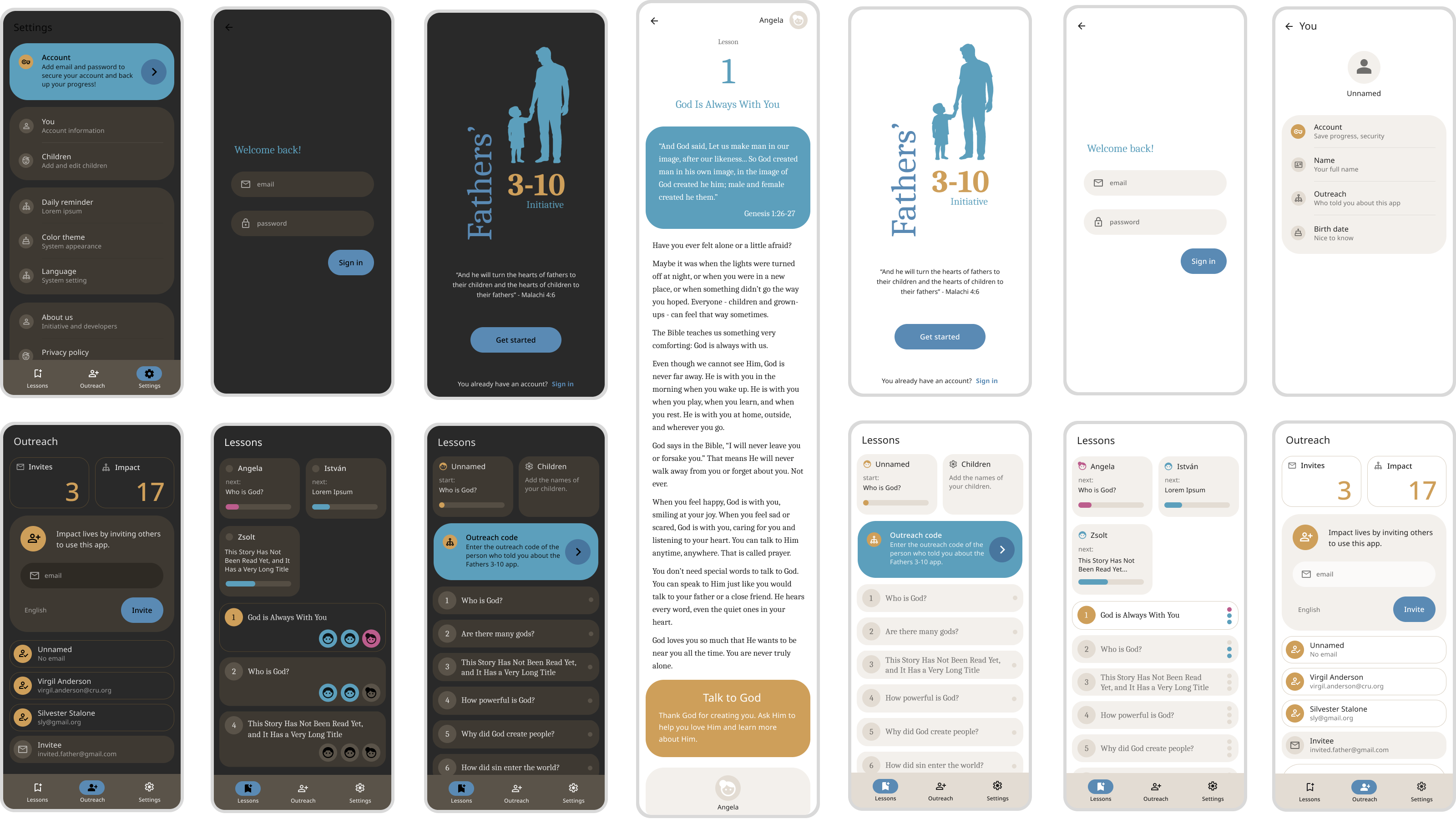
The native, localized mobile application that we developed transformed the program into a living global movement. It created one unified platform where fathers can access content in their own language, track their children's spiritual journey, preserve meaningful moments, and stay connected to a community of other fathers walking the same path, all while giving the initiative real visibility, structure, and scalability.
This is not just a digital version of printed material, it is infrastructure. It enables global reach, real engagement, measurable impact, data-driven growth, and long-term sustainability. It turns individual, invisible efforts into a connected ecosystem with shared momentum, accountability, and motivation. It gives the Fathers' 3-10 Initiative the tools it needs to grow responsibly, strategically, and globally in the modern world.
The frontend was developed with the Flutter framework, using the Dart language. This allowed us to build high-performance and natively compiled applications for both Android and iOS.
The backend is built on a cost-effective single Linux server, with a clear migration path to cloud-based services when needed. The REST API utilizes Node.js and Express.js, with MySQL as the database. The code was written in TypeScript.
Design was done in Figma following Google Material Design guidelines. Both the Android and the iOS versions received the same design to ensure a consistent user experience and brand identity. Special care was taken to respect users' custom OS accessibility settings.
Localizations are handled automatically without having to publish a new version of the app. Our custom backend service regularly reads Google Sheets for any updates, and prepares JSON localization files. The client apps check in to the localization service periodically to see if anything needs updating. If there is a new language available, or if any changes were made, those are applied in the app automatically. Part of the dart localization related code was automatically generated by custom processes.
Users are arranged in a nested set model to efficiently manage their hierarchical relationships, which are established by scanning personal QR codes, entering individual outreach codes, or are automatically identified by our smart algorithms.
The app will be available for all devices this summer.
We are available for other projects. Please contact us.